

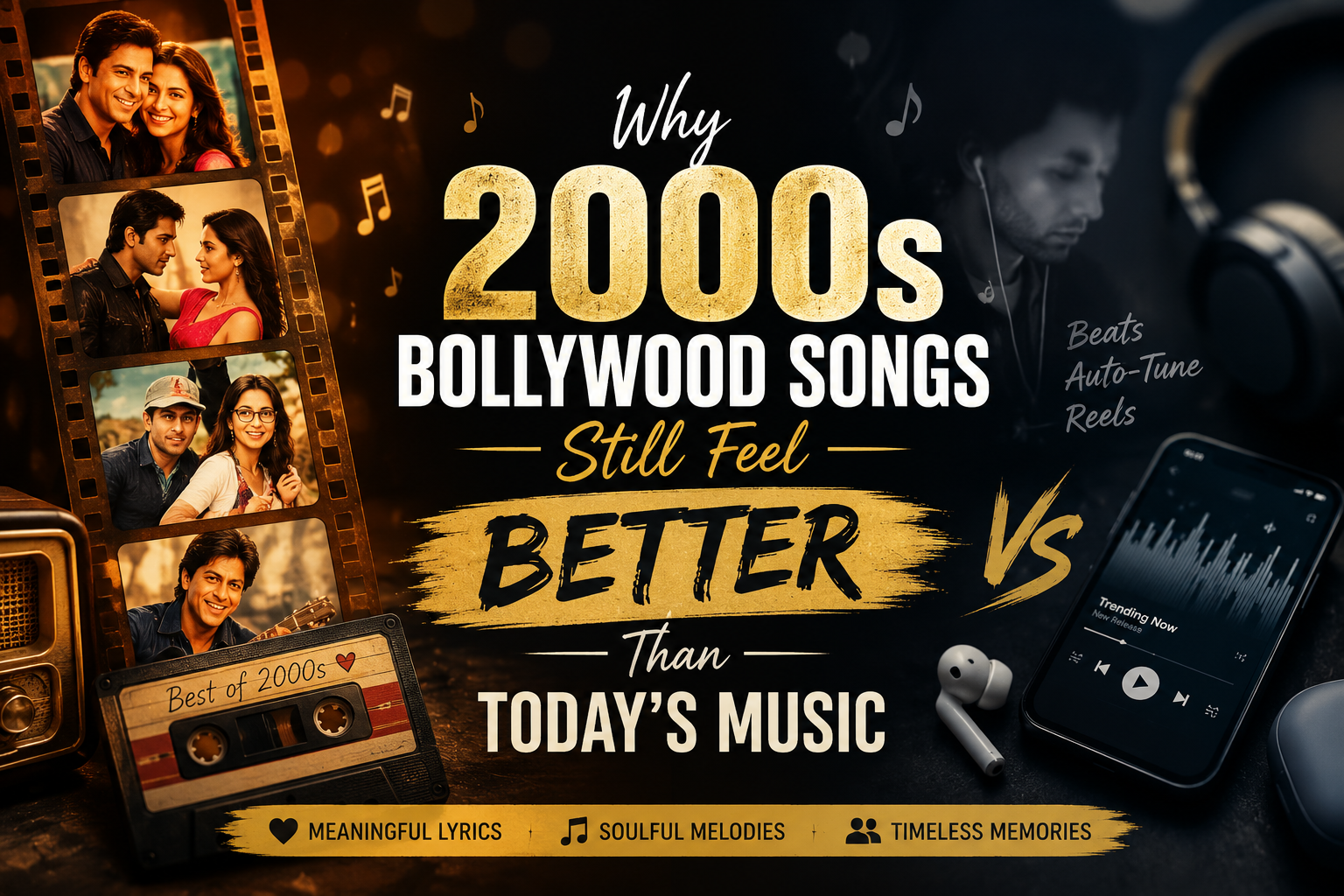
Put on Kal Ho Naa Ho at 11 PM on a rainy night and something extraordinary happens.
The melody begins. The first note settles into the room. And within seconds — before a single word is sung — you feel something. Something warm and specific and achingly familiar. A memory surfaces without being called. A feeling you thought you had forgotten finds its way back to the surface.
That does not happen with most music made today.
It is a conversation happening everywhere in India in 2026 — in offices, in college common rooms, at dinner tables, and across every social media platform where music gets discussed. Why do the songs from the 2000s hit differently? Why does a twenty-year-old Bollywood track create more feeling than something released last month? Why is a generation that was not even born when Dil Chahta Hai released now building entire playlists around its soundtrack?
These are not simple questions. The answers reach into music theory, neuroscience, cultural history, and the way human beings form emotional bonds through sound. This blog explores all of it — honestly, deeply, and from the perspective of someone who performs both retro classics and contemporary Bollywood live at weddings and events every week.
The Numbers First — 2000s Bollywood Is Actively Trending in 2026
Before getting into the why, it is worth establishing that this is not just a feeling — it is a documented, measurable cultural phenomenon happening right now.
Vintage Bollywood songs are trending across social media platforms in 2026 — with Reels, YouTube Shorts, and Instagram content built around 2000s tracks consistently outperforming content built around newer releases. Streaming platforms report that tracks from Jab We Met, Kal Ho Naa Ho, Dil Chahta Hai, and Kabhi Khushi Kabhie Gham are all experiencing significant streaming increases as younger listeners discover them for the first time.
Gen Z is bringing back 2000s Bollywood songs and they are not letting go — not just out of nostalgia, but because they stand the test of time.
The nostalgia-seeking is so prominent that there are accounts on Instagram solely dedicated to posting popular content from the 2000s.
And at Indian weddings — where I perform every week across Jaipur and beyond — the pattern is unmistakable. Couples in their mid to late twenties, planning their 2026 weddings, are consistently requesting retro Bollywood songs for their most emotionally significant moments. The bride’s entry. The first dance. The sangeet’s emotional peak. The vidaai.
Something real is happening here. And it deserves a real explanation.
Reason 1 — The Songs Were Stories, Not Singles
The most fundamental difference between 2000s Bollywood music and most of what is made today is this: the songs of that era were built to serve stories.
A song in a 2000s Bollywood film was not a standalone product designed to go viral on social media. It was a chapter in a narrative — it existed in relationship to characters, emotions, and plot moments that gave it meaning beyond the melody itself.
Songs from that era were not just chart-toppers — they were storytelling tools. When you heard Tujhe Dekha Toh Yeh Jaana Sanam from Dilwale Dulhania Le Jayenge, you were not just hearing a love song — you were hearing two characters falling into each other’s world, with all the longing and hope and uncertainty that carried. The song was inseparable from the story.
What made 2000s Bollywood songs so powerful was their storytelling. A song was not just a track — it was an emotional lifeline. Whether you were in love, grieving, growing up, or just vibing with friends, there was a song for you. These were not generic tracks — they were personal.
Today, a significant portion of Bollywood music is produced as standalone content — engineered for streaming algorithms, designed for the first fifteen seconds of a Reel, and optimised for discoverability rather than emotional depth. The song exists for the platform, not the story. And audiences — especially younger audiences who have never been told what they are supposed to like — can feel that difference immediately.
Reason 2 — The Melodies Were Built to Last
There is a technical dimension to why 2000s Bollywood music stays in your head in a way that most contemporary production does not.
The composers of that era — A.R. Rahman, Shankar-Ehsaan-Loy, Vishal-Shekhar, Jatin-Lalit, and their contemporaries — were working within a tradition of melody-first composition that stretches back to the golden era of Hindi film music. A song needed a hook that could be hummed without any production behind it. The melody itself had to be the point — because without a strong melodic core, nothing else could carry the song.
Think about Vande Mataram from 1997. Tere Bina from Guru. Dil Se. Kuch Kuch Hota Hai. Strip away every instrument, every production element, every audio effect — and the melody alone tells you everything you need to know about what the song is trying to say. That is the mark of great melodic composition.
A significant portion of contemporary Bollywood production relies on sound design, sampling, digital production layers, and borrowed melodies — either from regional music, international pop, or remixes of older songs — rather than original melodic composition. The song sounds impressive. But when you try to hum it the next morning, there is nothing there to hum.
The 2000s gave us melodies that live independently of their production. That is why they feel better. They are better — in the specific, technical sense that the underlying composition is stronger.
Reason 3 — The Lyrics Meant Something
Open any major Bollywood song from 2000 to 2010 and read the lyrics as a poem.
Sandese Aate Hain. Tum Se Hi. Kabhi Alvida Naa Kehna. Ae Ajnabee. Ek Ajnabi Haseena Se. These lyrics hold up as writing. The images are specific. The emotions are complex. The language moves between registers — from the elevated Urdu vocabulary of classical poetry to the everyday conversational Hindi of real human emotion — in ways that feel deliberate and crafted.
Now do the same exercise with a random selection of 2024 and 2025 Bollywood releases. In many cases, the lyrical content is repetitive, generic, and interchangeable. The same words appear in song after song — love, dance, night, eyes, heart — assembled differently but saying nothing new. The language is simplified to the point where it carries almost no literary weight.
This is not an accident. Songs optimised for streaming metrics are typically shorter, with simpler language, simpler rhyme schemes, and shorter verse structures — because the algorithm rewards completion rates and replay counts, not lyrical complexity. A song with dense, poetic lyrics asks more of a listener — and on a platform optimising for passive consumption, that is a commercial risk.
The result is music that is easy to consume and difficult to remember. Precisely the opposite of what a great Bollywood lyric is supposed to do.
Reason 4 — The Voices Were Trained for Feeling, Not Processing
This is perhaps the most emotionally resonant reason of all — and the one that connects most directly to the experience of live music.
Singers from the 2000s focused more on connecting with the audience than creating a spectacle. Udit Narayan, Sonu Nigam, Kavita Krishnamurthy, Alka Yagnik, Kumar Sanu — these voices were trained in classical Indian vocal traditions before they ever entered a recording studio. They understood breath control, emotional phrasing, the relationship between a vowel and its feeling, the way a sustained note can communicate something that words cannot.
When Sonu Nigam sang Kal Ho Naa Ho, he was not delivering a vocal performance — he was inhabiting an emotion and transmitting it through his voice. The technical precision of his classical training was in service of something deeply human. You could hear the training and the feeling simultaneously, and that combination is what makes the voice of a great singer different from every other voice in the world.
Nostalgia bias involves emotional attachment, formative memories, and the role of music in life milestones — these factors make older songs feel better to people who grew up with them. But nostalgia alone does not explain why Gen Z — a generation with no personal memories attached to these songs — is discovering and embracing 2000s Bollywood in 2026. The explanation is simpler: the voices are genuinely extraordinary, and the emotional quality of a great voice is not era-specific. A twenty-year-old discovering Udit Narayan for the first time in 2026 hears exactly what audiences heard in 1999 — a voice that communicates feeling with extraordinary precision.
This is also why live performance of retro Bollywood creates such a powerful response at events. When a professional live singer performs a 2000s classic — with the same emotional intention that made the original recording special — the song finds new emotional life in a new context. The melody unlocks memories in the older generation and creates entirely new emotional associations in the younger one.
Reason 5 — The Songs Were Made for Every Generation Simultaneously
One of the most remarkable qualities of 2000s Bollywood music that is rarely discussed is its genuine cross-generational appeal.
A song like Kuch Kuch Hota Hai worked for a grandmother because it used the classical melodic language she had grown up with. It worked for a parent because it was contemporary and cinematic. It worked for a teenager because Shah Rukh Khan was in the film. And it worked for a child because it was joyful and warm.
That multi-generational accessibility was not accidental — it was a feature of how Hindi film music was composed during that era. Composers like A.R. Rahman deliberately worked with classical Indian musical structures while incorporating contemporary production — creating a sound that felt both timeless and modern simultaneously.
Contemporary Bollywood production is increasingly stratified by age demographic. Music made for streaming algorithms is primarily targeted at listeners between 18 and 34 — because that is the demographic that streaming platforms monetise most effectively. Songs optimised for this audience are deliberately not trying to appeal to a grandmother or a ten-year-old. And as a result, they do not create the kind of shared musical experience that 2000s Bollywood did — where three generations in the same room all felt the same thing at the same time.
This is exactly why retro Bollywood songs are so consistently powerful at Indian weddings. A wedding is one of the few occasions where three or four generations are in the same room together. And the songs that work for everyone — the songs that get a grandparent and a college student on the dance floor simultaneously — are almost always from the 2000s.
Reason 6 — They Were Attached to Films That Actually Made You Feel Something
The relationship between a song and the film it comes from is more important than most people realise.
Even in the 2000s, films like Jab We Met and Kal Ho Naa Ho had soundtracks that stayed with audiences long after the credits rolled — because the songs were inseparable from the emotional impact of the films themselves.
When you hear Tum Se Hi from Jab We Met, you do not just hear a melody — you feel the specific quality of Shahid Kapoor and Kareena Kapoor’s chemistry in that scene. You remember where you were when you first watched that film. The song is a portal back to a complete emotional experience — not just a audio memory but a visual, emotional, and narrative one.
This is the most powerful form of musical memory: not just the song, but everything the song was attached to. And 2000s Bollywood films — with their genuine storytelling, complex characters, and cinematically beautiful compositions — gave their songs so much to be attached to.
When you hear the music from a streaming-era Bollywood release that you watched on your phone while multitasking, the song has almost nothing to be attached to. It exists in your memory as isolated audio — floating, unmoored, without the emotional context that gives music its depth.
Reason 7 — They Sound Extraordinary Performed Live
This is the dimension of 2000s Bollywood music that I can speak to from direct personal experience as a live singer.
The songs of that era are built for voice in a way that much contemporary music is not. The melodic structures, the lyrical breath patterns, the emotional arc of the compositions — all of these were designed to be sung by a trained human voice, in front of a live audience, with nothing between the singer and the listener except air.
When I perform Tere Bina from Guru at a wedding ceremony, or sing Kabhi Khushi Kabhie Gham at a sangeet, or deliver Kal Ho Naa Ho at a reception — the songs come alive in a way that their studio recordings hint at but never fully deliver. The live voice adds dimensions that the recording process inevitably compresses. The room acoustics respond to the melody in ways that digital playback cannot replicate. And the emotional presence of a real singer — someone in the room, feeling the song and directing it at the people present — transforms the music into an experience.
From Instagram reels to Spotify playlists, these golden hits are a musical discovery zone for Gen Z, who find emotional depth, rich melodies, and cultural texture in every line. And when that same emotional depth is delivered through a live performance at a wedding or event — rather than through earphones on a commute — the impact is magnified many times over.
This is why the couples planning their 2026 weddings who care most about music consistently ask for retro Bollywood songs at the moments that matter most. They know — instinctively, even if they cannot articulate it technically — that these songs hold the emotion they need for those moments. And they are right.
For the best retro Bollywood songs for your wedding sangeet, explore the top sangeet songs 2026 guide which includes a dedicated retro section. For bride entry moments, see the best bride entry songs for Indian weddings 2026. For the groom’s entry and baraat, the best groom entry songs 2026 covers the full retro and contemporary spectrum.
The Counter-Argument — Is Today’s Music Really That Bad?
Intellectual honesty requires acknowledging the other side of this conversation.
Contemporary Bollywood blends EDM, hip-hop, trap, reggaeton, indie, and global pop — this diversity appeals to younger, globally connected audiences and offers fresh textures and sonic experimentation that older Indian film music never attempted.
And the nostalgia argument has its own complications. Some make the mistake of looking at the 2000s through rose-tinted glasses — every era has its challenges, and the content that survives from any era tends to be the best of it, not the average of it. The 2000s also produced a great deal of forgettable music. What we remember is the cream — Kal Ho Naa Ho, Dil Chahta Hai, Jab We Met — not the dozens of mediocre films and soundtracks that surrounded them.
Today’s Bollywood also has its genuine high points — Kesariya, Raataan Lambiyan, Ve Kamleya, and the broader Arijit Singh canon represent melodic composition at the highest level. The indie Bollywood scene, in particular, is producing music of genuine depth and originality that the mainstream conversation often overlooks.
The honest answer is that every era produces both great music and forgettable music. What the 2000s had that today’s industry arguably lacks is a consistent structural commitment to melody-first composition and emotional depth over algorithmic optimisation. That structural difference — not the nostalgia — is what makes the best 2000s Bollywood feel better.
Why Retro Bollywood Songs Work Best at Weddings in 2026
There is a specific reason why retro Bollywood is experiencing such a strong resurgence at Indian weddings in 2026 — and it goes beyond nostalgia.
Weddings are multi-generational events. The guest list spans grandparents in their 70s and 80s, parents in their 40s and 50s, the couple’s contemporaries in their 20s and 30s, and children who are just beginning to form their musical memories. The only music that genuinely serves all of these people simultaneously is the music that was built to cross generations — and that is almost exclusively the music of the 2000s and the golden era before it.
A well-designed wedding setlist in 2026 uses contemporary Bollywood for the couple’s personal moments — their first dance, their entry songs, their specific romantic dedications — and retro Bollywood for the moments that need to include everyone in the room. The sangeet peak where grandparents stand up and dance alongside their grandchildren. The reception segment where the entire family sings along together. The vidaai where a melody carries the full weight of everything a family is feeling.
The most memorable weddings I perform at are the ones that use this balance consciously — contemporary for the personal, retro for the collective. It works every time.
For a complete guide to building this kind of balanced wedding setlist, explore the 150 best wedding songs 2026 playlist which covers both retro and contemporary songs across every function. For first dance song choices that blend retro and contemporary, explore the best first dance songs for Indian weddings 2026.
The 10 Best 2000s Bollywood Songs That Still Sound Incredible Live in 2026
As a live singer who performs retro Bollywood at weddings and events every week, these are the ten 2000s songs that consistently create the most powerful responses from live audiences in 2026:
Kal Ho Naa Ho — The song that makes every room fall silent when the opening melody begins. Its combination of joy and underlying melancholy is uniquely powerful.
Tere Bina — Guru — A.R. Rahman’s masterpiece of restraint. When performed live, its emotional depth is almost unbearable.
Tum Se Hi — Jab We Met — The most perfectly constructed romantic Bollywood song of the 2000s. Every element serves the emotion.
Dil Chahta Hai — Dil Chahta Hai — Joyful, free, and permanently attached to the feeling of youth and possibility.
Kuch Kuch Hota Hai — The song that works for every generation, every mood, and every moment. Indestructible.
Pehli Nazar Mein — Race — One of the most melodically beautiful songs of the late 2000s. Performs extraordinarily well live.
Tujhe Bhula Diya — Anjaana Anjaani — The song that hurts in exactly the right way. Audiences connect with it immediately.
Iktara — Wake Up Sid — Deceptively simple. Extraordinarily moving when performed live in the right acoustic setting.
Khuda Jaane — Bachna Ae Haseeno — One of the most complete love songs of the 2000s — romantic, honest, and melodically exquisite.
Dil Se Re — Dil Se — A.R. Rahman at his most adventurous. When performed live, it creates a completely unique emotional atmosphere.
How Live Performance Gives These Songs New Life in 2026
When a live singer performs a 2000s Bollywood classic at a wedding or event in 2026, something interesting happens. The song simultaneously activates two completely different emotional responses in the same room.
For the older generation — those who were young when these songs first played — the live performance unlocks memory. The melody is a portal back to a specific time, a specific feeling, a specific version of themselves. The live voice adds a new dimension to a memory they have carried for twenty years.
For Gen Z — discovering these songs through streaming and Reels — the live performance is a revelation. They have heard the recording. But hearing it performed by a real voice, in real time, in the same physical space they are occupying, is a completely different experience. It is not a memory being unlocked — it is an entirely new emotional association being formed.
Both responses are powerful. And both happen simultaneously in the same room when a live singer performs retro Bollywood with genuine feeling.
This is one of the reasons I believe that 2000s Bollywood music will not just continue to trend in 2026 — it will become increasingly central to live performance culture at Indian weddings and events for years to come. The songs are strong enough to keep finding new audiences. And live performance is the medium that allows them to do so most powerfully.
For couples who want retro Bollywood to be a genuine part of their wedding entertainment — performed live, with full emotional presence — explore the wedding singer services in Jaipur and destination wedding singer services worldwide.
Frequently Asked Questions
Why are 2000s Bollywood songs trending again in 2026?
Several factors are driving the resurgence. Gen Z discovering these songs through streaming and social media, the genuine melodic and lyrical superiority of the compositions, and a broader cultural nostalgia movement that values emotional authenticity over algorithmic optimisation. The songs were simply built better — and good music always finds its way back.
Which 2000s Bollywood songs work best for weddings in 2026?
Kal Ho Naa Ho, Tere Bina, Tum Se Hi, Kuch Kuch Hota Hai, and Dil Se Re are among the most consistently powerful retro Bollywood songs for wedding moments in 2026. For a complete function-wise guide, read the top sangeet songs 2026 and 150 best wedding songs 2026.
Is it better to play 2000s Bollywood songs from a recording or have them performed live at a wedding?
Live performance is significantly more powerful for emotionally significant moments. A live singer performing retro Bollywood at a bride’s entry, first dance, or vidaai can adjust in real time — holding the emotional moment, responding to the room, and creating something unrepeatable. Read more about why a live singer is better than a DJ for Indian weddings.
Why do 2000s Bollywood songs feel more emotional than today’s music?
The primary reasons are stronger melodic composition, more complex and poetic lyrics, vocals trained in classical Indian traditions, and the narrative depth that came from songs being written as storytelling tools within films rather than standalone streaming content.
What is the best 2000s Bollywood song for a couple’s first dance at a wedding?
Tum Se Hi from Jab We Met, Kal Ho Naa Ho, and Khuda Jaane from Bachna Ae Haseeno are among the strongest retro Bollywood first dance choices. For a complete guide, explore the best first dance songs for Indian weddings 2026.
Also Read
- Top Sangeet Songs 2026 — Trending Playlist Including Retro Favourites
- Best Bride Entry Songs for Indian Weddings 2026
- Best Groom Entry Songs 2026 — Retro, Bollywood & Punjabi
- Best First Dance Songs for Indian Weddings 2026
- Best Vidaai Songs 2026 — Most Emotional Bollywood Tracks
- 150 Best Wedding Songs 2026 — Complete Playlist
- Why Live Singer is Better Than DJ for Indian Weddings
- Indian Wedding Music Trends 2026
- Gen Z Wedding Trends 2026 — Live Music, Viral Reels & Emotional Moments
Want These Songs Performed Live at Your Wedding?
The 2000s Bollywood songs that moved you the most deserve to be performed live — not played from a speaker. Harshit Sharma is a professional live singer based in Jaipur performing retro Bollywood, contemporary hits, Sufi, Punjabi, and acoustic songs at weddings and events across India and internationally.
Check Availability for Your Wedding →
📞 WhatsApp / Call: +91 7733868936
📩 Email: harshitsharmalivemusic@gmail.com
📸 Instagram: @harshitsharmamusic


2 responses to “Why 2000s Bollywood Songs Still Feel Better Than Today’s Music”
The distinction between the deep emotional resonance of 2000s melodies and the often fleeting nature of today’s tracks really resonates, especially when looking at how those older songs trigger such vivid memories during rainy nights. It’s fascinating to hear your perspective from the front lines of the event industry, confirming that these classics still hold a unique power to connect audiences across different generations. Your point about the cultural shift back to music that feels ‘archically familiar’ really highlights the missing emotional depth in much of the current releases.
Your point about the neuroscience behind why vintage tracks trigger such immediate memory recall is brilliant and really explains the emotional disconnect with much of today’s formulaic music. It makes total sense that as a performer, you observe generations building entire playlists around songs they never actually lived through to find that same sense of warmth. The idea that we are actively seeking ‘authenticity’ over algorithmic perfection in 2026 is a fascinating cultural shift worth exploring further.